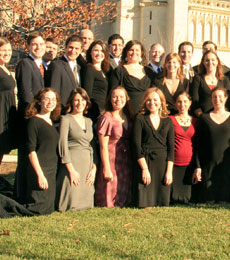
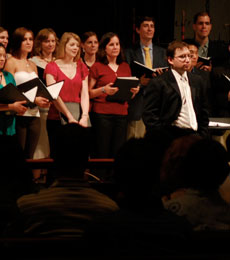
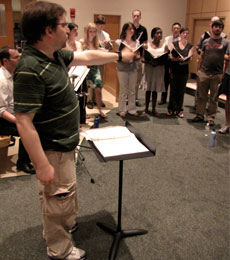
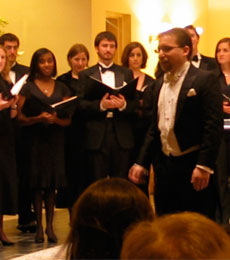
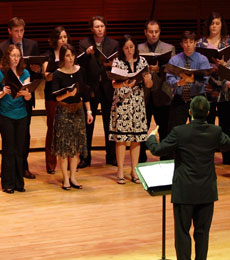
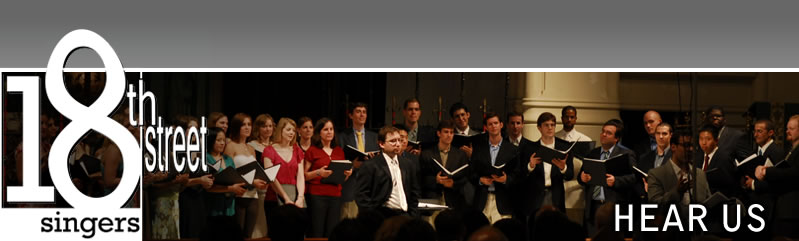
Our debut recording is comprised of a collection of live performances from 2006 to 2007 that represent the diverse repertoire of The 18th Street Singers.
With A Lily In Your Hand
Eric Whitacre (Jun. 2007)
"With a Lily In Your Hand" is the second of Eric Whitacre's (b.1970) "Three Flower Songs" cycle. The text is a translation of a poem by Spanish poet Federico Garcia Lorca written most likely in 1921. This melancholy poem is colored by Lorca's personal struggles with his homosexuality, and the text is filled with veiled imageries of longing, intimacy, ecstasy, and fulfillment. The philosophy of Lorca's writing was to elevate the concrete to something cosmic, abstract, and magical. Fittingly, Whitacre's dramatic composition uses intense crescendos, bold dissonances, driving rhythms and shifting tempos to leave the listener bewildered, entranced and awe-struck.
Sleep
Eric Whitacre (Jun. 2007)
The words to "Sleep" come from the poet Charles Anthony Silvestri, who was asked by Eric Whitacre to compose a poem for a piece of music he had already completed. This rare example of a modern poem that was written with a particular composition in mind resulted in a work in which the words chosen were those whose emotional impact would be best conveyed by the music. The relationship between the text and the music in this piece is therefore mutually reinforcing and profoundly empathetic. Together with the text, the heavy and resonant chords that begin the piece and the momentary dissonances heighten the feeling of someone who is tired, distracted by "a thousand pictures in [the] head," slowing falling asleep. A soaring crescendo later on, followed by gradual diminuendos, amplifies the exhilarating dreams that enter the mind and the peaceful slumber that eventually follows.
I Love My Love
Traditional, arr. Gustav Holst (Jun. 2007)
"I Love My Love," a folksong from Cornwall, England, was arranged by the English composer Gustav Holst (1874-1934) as one of his "Six Choral Folksongs" of 1916. Its haunting lyrics tell of a young man sent to sea by his parents. His sweetheart was so distraught that she had to be confined to Bedlam, the notorious London mental institution. In Holst's arrangement, the voicing and harmonies vary in close relation to the text. In the earlier verses, the female parts have a disjointed, modern sound that suggests the woman's emotional agony and desperation; later, when the verses speak of the young man's discovery, on his return from sea, that his sweetheart was in Bedlam, the male voices rise to a frenzied crescendo. The final verses blossom into rich harmonies befitting the story's happy ending, when the two are reunited and married.
Rise Up, My Love
Gordon Young (Jun. 2007)
Rise up, my love, my fair one, and come away;
For, lo, the winter is past, the rain is over and gone;
The flowers appear on the earth; the time of the singing of birds is come, and the voice of the turtle [dove] is heard in our land.
These beautiful words in "Rise Up My Love" come from the biblical Song of Solomon (also known as Canticles), found in the Old Testament between Ecclesiastes and Isaiah. The verses tell a love story in the form of a dialogue between a man and a woman as they move from courtship to marriage, which some take to be an allegorical representation of God's love for humanity. This setting by Gordon Young (1919-1998) is at once unconventional and accessible, blending elements of sacred choral music with more modern chord constructions and transitions to bring a decidedly secular element to the sacred text.
Traditional, arr. Donald James (Jun. 2007) Solos: Catherine Rodman, Matt Cook
Like many of the British folks songs collected by Ralph Vaughan Williams (1872-1958), "Bushes and Briars" tells a story that is narratively vague but psychologically vivid. A young woman (soprano solo) begins the piece by telling us she is wandering through the countryside "to hear the small birds sing." Her lover (the baritone solo) tells us he overhears his beloved say to herself, "I am uneasy and troubled in my mind...I think I'll go to my love and tell to him my mind." The young woman however resolves to hide her secret by confiding in us that if she were to "show to him my boldness, he'll ne'er love me again." We never learn why the woman is uneasy or what becomes of these two lovers, but the ebb and flow of the polyphonic lines in this haunting and plaintive arrangement reveal the young woman's varying feelings of confusion, loneliness and determination.
Witness
Traditional, arr. Jack Halloran (May 2006)
"Witness," arranged by Jack Halloran (1916-1997), is a favorite of the 18th Street Singers. The lyrics of this spiritual recount wittily several stories from the Old and New Testaments, weaving the individual narratives into a sermon about the importance of bearing witness to God. Halloran was an Iowa-born songwriter and radio conductor who worked with musicians including Bing Crosby, Dean Martin, Ray Charles, Pat Boone and Frank Sinatra to popularize jazzy mid-. This up-tempo arrangement of "Witness," with its percussively rhythmic backbone of parallel chords and its precise interplay of voice parts, recalls the disciplined, tight sound of a Sunday gospel service.
Kom du Ljuva
Adam de la Halle, arr. David Connell (May 2006) Solo: Ali Golden
"Kom du Ljuva" ("Come, my Dearest Sweetheart") is a famous Swedish serenade by Adam de la Halle (c.1240-c.1286). The text speaks of a profound romantic love - a love that brings peace to the heart. While the piece is traditionally sung by men, this intricate arrangement by the American choral director David Connell (b.1960) uses the interplay between the male and female voices to introduce a new dynamic to this traditional piece. An exquisite soprano descant floating high above the melody evokes a tender feeling of beauty and serenity.
M'khalk‘l Chayim
Abba Weisgall (Dec. 2006)
Born in the Austro-Hungarian Empire during the early twentieth century, Abba Joseph Weisgall was trained in both Jewish cantorial music and the classical tradition. Written while Weisgall served in the trenches of the First World War, "M'khalkel Chayim" is a setting of one of the so-called Eighteen Blessings that lie at the heart of the daily Jewish service. The prayer describes God's unique power: whereas all kings, earthly and divine, can strike dead, only the King can raise back to life. "You support life... you revive the dead... You uphold the falling, and heal the sick, and free the captive, and keep faith with those who sleep in dust... You put to death, and revive, and cause salvation to spring forth like a flowering plant." The piece's alternation of fast, driving passages and slow, dragging ones evokes both traditional Jewish forms such as the doyna and other works of classical music inspired by the Great War, such as Britten's War Requiem.
Ashita wa hare kana, Kumori kana
Toru Takemitsu (Dec. 2006)
Toru Takemitsu (b.1930) is among the most important of those Japanese composers who have written music in the Western tradition. He first became interested in western classical music around the time of World War II. Largely self-taught, he was greatly influenced by French music, in particular that of Claude Debussy, and jazz, such as the music of Duke Ellington. Takemitsu is noted for preserving a fundamental Japanese identity in his music, bringing his awareness of Japanese musical traditions into a remarkable and very original synthesis with his Western-style compositions. "Ashita wa Hare kana, Kumori kana" ("Will Tomorrow, I Wonder, be Cloudy or Clear?") speaks to the uncertainty of the future and makes use of complex jazz-like harmonies and rhythms and short contained phrases to express a sense of pensiveness and unpredictability. Its bright and airy quality, however, also leaves listeners with a feeling of optimism that the future bodes well.
Traditional, arr. Stephen Caracciolo (May 2006) Solo: Rasika Teredesai
There are varied opinions as to the origin "Wayfaring Stranger," but its lyrics suggest it sprang from the spiritual tradition of African slaves. This song has been widely adapted, including by solo artists such as Johnny Cash, Dusty Springfield, Eva Cassidy, and Natalie Merchant. "Wayfaring Stranger" speaks of a journey to a home far away and conveys embattled resolve and an enduring hope that through whatever hardship life brings, the journey will take the faithful to a better place. In spirituals, crossing "Jordan" is often used to refer to reaching freedom or Heaven, which gives powerful meaning to the refrain of this piece, "I'm only go'in over Jordan, I'm only go'in over home." Stephen Caracciolo's (b.1962) moving arrangement uses different meters in the melody and the harmonic lines to evoke a sense determination in the face of a tumultuous world.
Annie Laurie
Lady Jane Scott, arr. Arthur Frackenpohl (Jun. 2007)
"Annie Laurie" is a Scottish folksong based on a poem by William Douglas (c.1672-1748) and adapted and set to music by Lady Jane Scott (1810-1900). It continues to be widely sung in Scotland. According to tradition, Douglas loved Anna, the youngest daughter of Robert Laurie, baron of Maxwelton in Dumfriesshire. They had met at a ball in Edinburgh and secretly betrothed themselves to each other. However, their two families were committed to opposing political forces and their union was not to be. This sensitive arrangement by the American music educator Arthur Frackenpohl (b.1923) uses the interplay of men and women singing the melody in turn and uncomplicated homophonic phrases to capture the purity of their love for each other.
Battle Hymn of the Republic
Traditional, William Steffe, Arr. Robert Edgerton (Dec. 2006)
One of our nation's most patriotic anthems, "The Battle Hymn of the Republic" was made popular during the American Civil War. The original words and music were written in 1853 by the South Carolinian abolitionist William Steffe (1830-1890), but the song did not become the "Battle Hymn of the Republic" until Julia Ward Howe, a poet and a leading suffragist, set the music to its present day lyrics in 1861. The lyrics she composed contained the words "let us die to make men free" - the most explicit reference to the fight to end slavery; in later years, when this song was sung in a non-military environment, this line was sometimes changed to "let us live to make men free". Together with the marching beat of this composition, the song expresses our nation's strength and our resolve to fight for freedom. This anthem was chosen to conclude the National Service of Prayer and Remembrance on Friday, September 14, 2001.
Black Sheep
Traditional, arr. John Rutter (May 2006) Solo: Jessamyn Berniker
John Rutter (b.1945) is an English composer and choral conductor. While he is widely admired for his sacred anthems and more extended choral works, Rutter has achieved acclaim in the United States for his American songwriting and arrangements. This arrangement of "Black Sheep," a traditional Appalachian folksong often sung as a lullaby, uses the female voices for a lilting melody and humming male voices to achieve a feeling of peacefulness and calm to the song.
Sleep, My Young One, Gently Rest
Traditional, arr. Leland Sateren (May 2006) Solo: Julia Franklin
Leland Sateren (1903-2007) is an American choral conductor and composer of Norwegian descent. In "Sleep, My Young One, Gently Rest," an Icelandic lullaby, Sateren draws from both his Scandinavian heritage and the American choral tradition, employing moving lines in innovative and unexpected ways to create a beautifully crafted arrangement.
"Kaval Sviri" ("The Flute Plays") is a Bulgarian folksong sung by women to begin a community or neighborhood gathering. The singing style of songs in the Slavic tradition calls for a bright, near-nasal tone and extensive use of dissonance - a distinct and remarkable sound. This arrangement makes wonderful use Slavic harmonies and rhythms, conveying a shifting color and mood throughout the piece through close dissonances, irregular meter, and dramatic dynamics.
Pusi Nofo
Traditional, arr. Christopher Marshall (Jun. 2007)
"Pusi Nofo" is a lighthearted arrangement of a traditional Samoan folksong by Christopher Marshall, a New Zealander who lived in Samoa for three years. Modern Samoan folk music blends traditional melodies with Western music and is typically sung for dancing. Here, the song's subject is a cat - "Hey, cat, sitting on the mat, how about catching some rats?"
Water Night
Eric Whitacre (Jun. 2007)
Eric Whitacre's arrangement of Octavio Paz's poem "Agua Nocturna," composed in 1995, is among the most popular new works of American choral music. The sequence of images that makes up "Water Night" is at once a philosophical meditation and an erotic vision. The mingling of reality and reflection recalls concepts in both Surrealism (which Paz encountered in France) and Buddhism (which he later studied in India). At the same time, Paz's synesthetic descriptions are lushly and unmistakably sensual. Whitacre builds on the intensity of Paz's words with the technique of sound-painting: in places, melodies convey the water's flow, while in others, dense tonal clusters built up from as many as fourteen notes create meditative and shimmering sounds.
"Ave verum corpus" ("Hail, true body") is a short Eucharistic hymn dating from the 14th century which has been set to music by various composers. This setting by William Byrd (c.1540-1623), one of the most celebrated English composers during the sixteenth century, is one of the best known. Byrd lived well into the Baroque period, but his composition style for voices remained true to the Renaissance. The simplicity of the polyphony in long and restrained phrases, shifting between minor and major chords, is one reason for the beauty and elegance of this work. Combined with creative avoidance of rhythmic emphasis on the first beat at certain points, Byrd evokes a dark and unsettled air to this hymn.
Ich bin das Brot des Lebens
Wolfram Buchenberg (Dec. 2006)
The German composer Wolfram Buchenberg (b.1962) and has won prestigious composition prizes for this work. "Ich bin das Brot des Lebens" ("I am the Bread of Life") is a German setting of Psalm 1,2 and John 6,35 and 6,51. The passages speak of eternal life that comes with belief in and obedience to God. But it is the music, in which the listener finds order from chaos, that the true meaning of this work becomes apparent; even when the confusion of the world surrounds you, we can hold on to our faith in God. To achieve this effect, Buchenberg juxtaposes dissonance with harmony, pairing narrow tonal clusters with wide expansive chords, and uses staggered and held notes that remove the feel of a regular rhythmic meter. In an unmoored and chaotic state, phrases, rhythms and notes find moments of harmony and unity, evoking a sense of faith in our common humanity.
Unicornis Captivatur
Ola Gjeilo (Jun. 2007)
Though "Unicornis Captivatur" was written by Ola Gjeilo (b.1978) in 2001, its text is a pastiche of medieval animal myths: a unicorn is captured and presented, wounded and bound, before a king; a pelican bleeds to death in its nest; a hydra fights a crocodile, and triumphs; a slain lion returns to life after three days. The text's strange and disparate episodes are pulled together, however, by a common symbolism. Each of these animal fables was a medieval metaphor for the death and resurrection of Christ and his triumph over evil - a point brought home by the repeated refrain, "Sing Alleluia to the dying lamb... Cry Alleluia to the victorious lion!" The strangeness of the stories recounted in "Unicornis Captivatur" is heightened by the colorful and unpredictable musical style.
"Shenandoah" is a favorite example of the work song - one of the great American folk traditions and a powerful influence in the American choral tradition. This melody was made popular by boatmen on the Ohio, Missouri, and Mississippi Rivers in the 1840s. Its origins are unclear, but many believe the song alludes to the Shenandoah Valley and River in Virginia. This arrangement by the American choral directors Marshall Bartholomew and Fenno Heath uses a languid tempo, expansive phrasing and the delicate layering of the upper voices to evoke a sense of place both concrete and abstract, bringing to mind both the water-borne rhythm of the boatmen's lives and a more general and profound sense of memory, longing and home.
* Conducted by Assistant Music Director, Ronald Lee. All other pieces on this recording were conducted by Artistic Director, Benjamin Olinsky.